Broadband Platform Services
Physics-based ground motion simulation on the SCEC Broadband Platform, with published verification and validation evidence.
The Broadband Platform computes the shaking an earthquake would produce
The SCEC Broadband Platform is open-source scientific software that produces synthetic seismograms: the ground motion time series a seismometer would have recorded at a given place, for an earthquake that happened or one that has not happened yet.
You give it a description of the rupture — magnitude, fault geometry, hypocenter — a crustal velocity model for the region, and a list of station locations with their site conditions. It returns the shaking at each of those stations, from long periods out past 20 Hz.
The reason to want this is coverage. Seismometers record the shaking only where they happen to be. Simulation answers the same question anywhere: at a town with no instrument, at a site being designed for, or for an earthquake on a fault that has not ruptured in the instrumental era.
How a simulation is assembled
A run is a chain of scientific modules, each one a step that a research group contributed and published. Low and high frequencies are computed by different physics and then combined, because no single method does both well.
What a run gives you
Not a single number. A run returns the full time series and the derived measures an engineer or seismologist would compute from it.
Seismograms
Velocity and acceleration time series, three components, one set per station.
Response spectra
RotD50 and RotD100 pseudo-spectral acceleration across periods, plus Fourier amplitude spectra.
The rupture it built
Slip distribution over the fault and a map of stations against it, so the source can be inspected rather than assumed.
Goodness of fit
Where recordings exist, bias against them period by period, not as a single average.
What this site adds
The platform, hosted and metered
The Broadband Platform is free and open source. Running it yourself means a Fortran build on Linux and tens of gigabytes of Green's functions per region. We do that once, so a simulation is an API call. The four ways to run the BBP, including the free ones →
The published record
Validated in the peer-reviewed literature
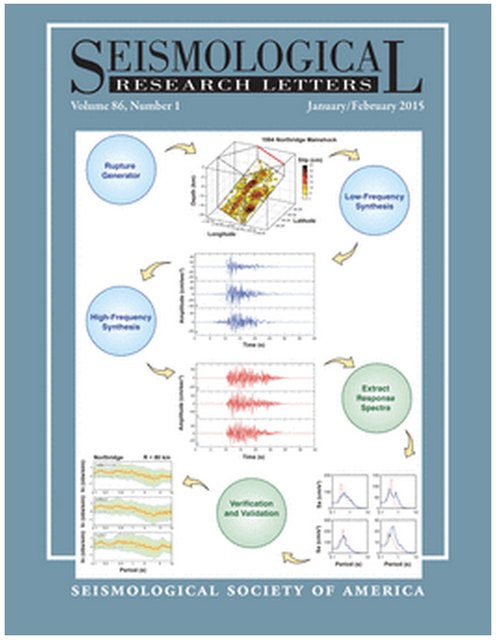
The Broadband Platform's validation exercise was published as a special issue of Seismological Research Letters in January 2015: nine papers covering the simulation methods, the validation events, and how the resulting ground motions compare with recordings. The cover diagrams the same chain shown above, which is the one this service runs for every job.
See our own validation results →
Cover image © Seismological Society of America, Seismological Research Letters 86(1), 2015. Reproduced for reference.